Business Planning for Starting a Wool Mill
Have you considered starting a wool & fibre processing mill but you aren’t sure where to start? Or maybe you want to add some processing equipment to your existing fibre farm or operation? This is an introductory workshop to business planning for a mill. This workshop will cover the following areas:
Industry overview and opportunities
Marketing considerations
Finances and Funding
Resources and Timeline
Q& A
Course Manual
Business Planning for Starting a Fibre Mill Manual
You can find the full text of the manual after the video.
This manual is Copyright 2022 Anna Hunter, Long Way Homestead
Course Video
Course Manual Content
Table of Contents
Industry Overview and Opportunities
Mills in Canada
Mill Equipment
What is your Why
Defining your Why
Mission/Vision and Goal setting
Marketing Considerations
Who are your customers
Custom Processing / Retail
Market Research
What makes you Unique
Sales Channels
Finances and Funding
Overview of Costs
Startup Costs
Return on Investment
Financial Planning
Resources and Timeline
Water
Wool
Timeline
Introduction
Have you considered starting a wool & fibre processing mill but you aren’t sure where to start? Or maybe you want to add some processing equipment to your existing fibre farm or operation? What are the key considerations for marketing, finances, timeline and resources that will ensure success for your wool & Fibre business.
These resources are based on the experience of Long Way Homestead Fibre Mill and will not reflect the variety and depth of experiences from mill owners across N. America. I encourage you to dig into the work, to research and write your own business plan and to talk to as many other mill owners as you can to acquire a variety of experiences and advice.
Ulitmately, we are writing the history or 'how-to' of small-scale textile processing in Canada. There are no courses or training programs on textile processing, no trade schools on running a processing mill – we are figuring this industry out as we go.
Industry Overview and Opportunities
Mills in Canada
In Canada there are three large mills remaining: Custom Woollen Mill in Alberta, Briggs and Little in New Brunswick, and MacCauslands in PEI. The only other mills in the country are the small and mini mills. The majority of the Canadian textile infrastructure was lost in between the 1920’s and the 1980’s. Sadly, the knowledge and systems for fibre production also disappeared.
Canada produces approximately 3 million pounds of wool annually. The majority of this is course or non-textile quality wool. Our sheep industry is predominantly producing lamb/meat and the wool is not considered an agricultural commodity. Combined with the loss of infrastructure to adequately process wool domestically means that 90% of all the wool grown in Canada is shipped overseas. The Canadian Cooperative Wool Growers purchases wool from producers and then sells it within the international market - but the majority is going to china.
The remaining 10% is being processed by the large and small mills leftover in Canada. There is great opportunity to access more wool, and to produce excellent products both for the niche fibre arts market, but also for the textile and semi-industrial markets.
Mills in Canada all have their own unique business models and structures. Some only do custom processing for sheep producers in their regions, and others do only their own fibre and/or retail production. Some do both. Some mills process exclusively sheep fibre and others only exotic fibre. Determining the opportunities should be a defining feature of a business plan and your market research.
From the Sheep & Wool Survey wait times and access to mills were identified as some of the greatest barriers for sheep producers in marketing their fibre. Many of the mills in Canada are struggling to keep their wait times short, or to keep up with the demand. Many regions across the country are underserved with no mills at all. There is great opportunity to provide a service for fibre producers and to build a thriving business.
Mill Equipment
There are two options for individuals looking to open a wool/fibre processing mill.
Purchasing new equipment
Finding and restoring old equipment
Both have advantages and disadvantages in acquiring and in running. I recommend you begin looking at the options for equipment right away. Talk to other mill owners about their experiences and what they have liked or disliked about the equipment they use. At Long Way Homestead we use Belfast Mini Mill equipment.
New Equipment Advantages
Good working condition
Limited training options from manufacturer
Easier access to parts and repairs
Easier use
Disadvantages
Smaller capacity
Older Equipment Advantages
Larger capacity
Well-constructed / durable
Disadvantages
Repairs and parts can be hard to find
Limited range (in processing)
Harder to find
Training and experience
Small Mill Equipment Suppliers
Belfast Mini Mills (https://minimills.net/)
Ramella (http://www.ramella.com/)
Stonehedge Fibre Mill Equipment (no longer selling equipment)
Marketing Considerations
Marketing is so much more than selling and advertising your product(s). It is the first step after defining your 'why', even more important than crunching the numbers for your future mill.
Who is going to buy your products and what are they all about.
For the purpose of this workshop we are focusing on the first crucial steps of a marketing plan. Of course you will also need to figure out your sales channels, distribution, advertising and/or social media. I encourage you to seek out helpful resources for this part of your business planning.
Who are your Customers
This is the most critical question if your mill business is to succeed. Who are you selling your products or services to. What do they want? What are they willing to spend? How often will they purchase your product? Where do they live? How will you reach them?
Most fibre mills focus on processing fibre into a product that they sell retail, or custom processing for other producers or a mix of both. Put some consideration into what you want to focus on in your mill and what the customer base for those options are.
Custom Processing
There is a large need for more mills to do custom processing across N. America. Many mills have months long wait lists for processing. What is it like in your region? Are there many mills and what sort of processing services do they offer. Some questions to consider for custom processing could be:
Are there many sheep producers in your area in need of custom processing?
How will your customers get their wool to you (are you in an easily accessible region or will it all be shipped)?
How will you build relationships with the producers in your region?
Can you offer custom services that no other mills are offering? (felting, roving, spinning, in house dyeing etc)
Retail or Wholesale
The yarn and fibre industry in Canada is large and growing, and the focus on purchasing local will make any small mill business a hit. As long as you have an effective way of getting your yarn in the hands of knitter, crocheters, weavers and spinners. The mark up on retail yarn is much higher than wholesale or custom processing, however, it requires more work to market and sell this product. Here are some questions to consider for retail or wholesale marketing
Will you sell the yarn/products yourself or will you try to wholesale them through existing stores/shops?
Where will you sell them?
fibre or farm markets: How many will you attend a year, what will your travel and set up look like, can you do that easily? Who will operate the mill while you are away selling at markets?
Bricks & Mortar or on farm store: How close are you to urban centres? How will people learn about your shop? Do you have mill parking, bathrooms, food, signage etc. What will be your operating hours and will you need staff? Will you sell other products or just your own?
On line store: what website / platform will you use? How will you photograph your items? How will you ship your items? How will you manage inventory for an online store. How will you reach customers for your online store?
Wholesale to existing LYS: What stores are in your region? Do they already focus on local or how will they promote your product in their shop? How many times a year would they order yarn/fibre. What are their wholesaling agreements (consignment usually a 70/30 split, or direct purchase at 50/50 retail price)
Market Research
Research should be the foundation of your marketing plan and strategy. The research will be something you can come back to during the other aspects of your business planning. The research will also help you define the aspects of your business that you perhaps are not aware of yet.
Market research can utilize many tools and strategies for finding information that will inform your sales marketing plan. You are not limited to internet or statistical research, but that can be useful as well. For example:
How many sheep farmers are in your region (use stats can, or provincial ag extension website)
How many sheep farmers in your region wish they had access to a mill (use a google survey with a list of questions and ask your local sheep association to send it out)
The market research can be more specific and methodical, or can be more informal and flexible. But it is essential you start these things in some form or another. It should include:
SWOT Analysis
What are the strengths, weaknesses, opportunities and threats of your business
Competetive Analysis
Who are your competitors and what are they doing? This will help you set your business and your products apart from what others are doing.
Buyer Persona / Ideal Customer Avatar
Who are your customers and what are they all about. This research is one of the most informative pieces for how you will market your products and what sales channels you will use.
I find it helpful to actually name and identify the things about my 'customer profiles' that I have researched. For example:
Customer Profile #1 (based on market research)
Katie is a 35 year old professional who loves to knit. She makes about $110,000/year and owns her own home with her partner and her cat. She attends knitting shows, her LYS and a stitch n bitch group. She prefers to ride her bike over a car, and shopping at the farmers market rather than big box stores. She has no aspirations to become a farmer, but she loves learning more about where her wool comes from. She spends between $50 - $200/month on yarn or yarn related items.
Understanding your customers, who they are, what they value, and what their income levels are will help you determine how to be effective at marketing your unique products. You can have multiple customer profiles for your business – but don't stretch yourself too thin. You can't be everything to everyone, and the most effective businesses know who they are and who they want to sell to, and they focus on that.
What Makes you Unique
Chances are you already came up with some ideas on what makes you unique while figuring out the competitive analysis. Now build on that to develop a brand for your business.
Prioritize your brand from day 1 – even if you don't have everything figured out. Define your brand and don't be afraid to stand behind it.
Brand / logo /appearance - work with a graphic designer if you don't' have those skills. (This was one of the smartest things I did in the beginning of our business, and it saved me so much time trying to use software I didn't know). You define your brand, not the other way around. Decide how you want to present your brand/business and be consistent. Take a content creation course (I can make recommendations) and determine from the beginning how you want to tell your story to connect with your customers.
Define your Sales Channel
Finally, you know what your product is, you know who your customers are, you have defined your brand – now what will your sales channels be?
At this early stage of business planning make a list of all the places and ways that you want to sell your product and what you need to do to get it there. Packaging, labels, shipping, product photos, look books, advertising, pattern support. Start big with this list and narrow it down as your business planning takes shape.
Get creative. Just because it hasn't been done before doesn't mean it won't work. (ie. Breed specific subscription)
What is Your Why?
Why do you want to open up a fibre processing mill? What will get you up every morning? What will be the reason you dig deep and do this hard work? Write down your why – and keep it close. Remember it when everything is covered in static and nothing will work. Remember it when you can't figure out why the carder is making a funny noise and you've spent half the day cleaning it. Remember it when customers are frustrated that you can't turn straw into gold – it'll keep you going.
My Why for LWH Field School:
To empower and educate other so that we can build regional, resilient textile systems.
What is your WHY? Here is some helpful words to develop your own why
TO ____ SO THAT ____.
The first blank represents your contribution — the contribution you make to the lives others through your WHY. And the second blank represents the impact of your contribution. Your job is to plug-in the blanks to create your own unique WHY Statement.
Mission/Vision/Goals
Defining a mission and vision statement can act as a guide as you go through the big questions of your business. A Mission Statement defines the company's business, its objectives and its approach to reach those objectives. A Vision Statement describes the desired future position of the company:
Mission: Long Way Homestead is a family owned and operated fibre farm and wool mill in Eastern Manitoba. We produce yarn, fibre and other products to the fibre arts community and provide custom processing services for other sheep and alpaca farmers in Western Canada.
Vision: Long Way Homestead works to promote and build up the Canadian Wool Industry through wool processing and sales, and also through education and advocacy. LWH recognizes the importance of local, resilient textile systems and believes that building capacity and infrastructure in Canada is vital to the health of our communities, economies and climate. LWH also advocates for the utilization of sheep, alpaca, bison and other fibre ruminants in the the management of grasslands, and landbases to build soil health, sequester carbon and mitigate climate change.
Goal setting: I encourage you to make some goals for your potential mill business. They don't have to be big, or grandiose, they can be simple and attainable. What do you want to see happen? Now post them somewhere, maybe in your office, or car, or journal – and don't lose sight of them.
What are your goals for the next year of building up a mill business?
What are your goals for the next 3 years?
The next 5 years?
Finances and Funding
I won't lie to you, opening up a wool/fibre mill is going to cost you money, AND the return on your investment (ROI) will take some time. This doesn't mean you shouldn't do it, but hopefully this course will ensure you have a more clear idea of what it will cost and how quickly you can expect to see a return.
The numbers included in this workshop are based on our experience and the experience of a few other mill owners I have spoken with. Prices may vary for every single business.
Overview of costs
The largest costs for a wool/fibre mill will be:
Equipment
Building (if you require a new one, or to renovate existing building)
Practise wool (trust me, you will want to pay for some of it)
At least one full year of capital while training on your machines
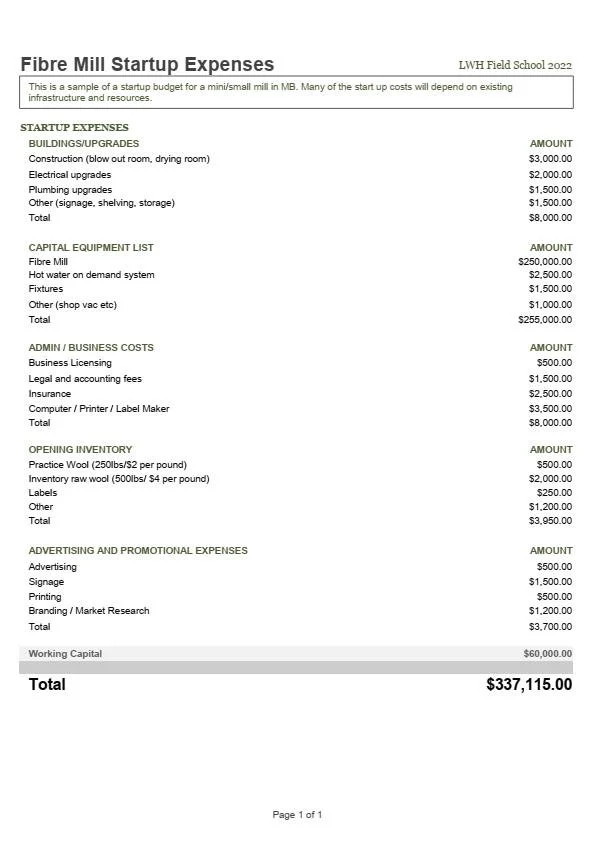
Please see the attached sample startup budget (appendix 1)
Return on investment
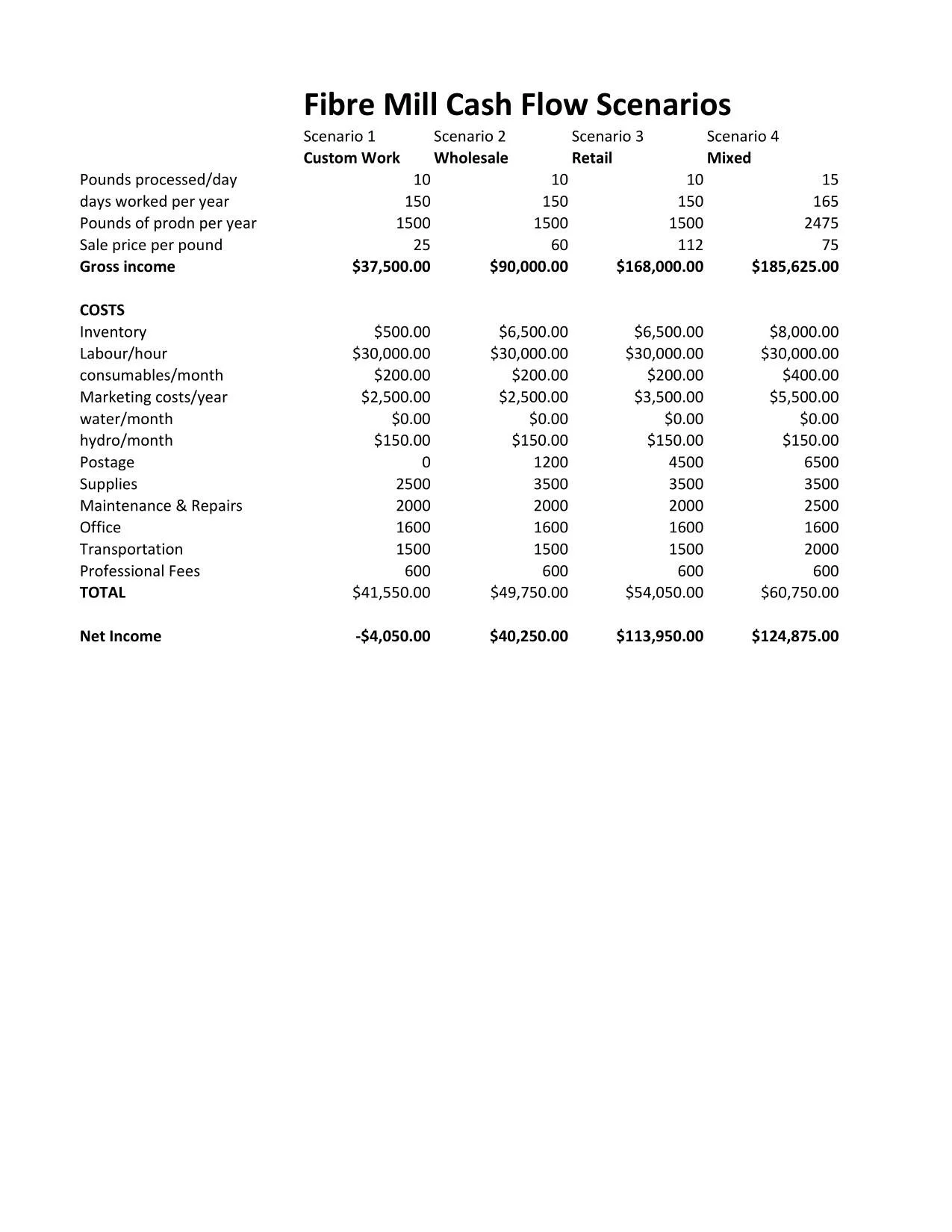
Please see the attached cash flow scenarios sheet.
What are the risks and what are the rewards. How can you reduce the risks?
Reduce the Risks
Find grants or other non-repayable money to help finance the start of your mill. Funding for specialty groups
Start your mill incrementally (carding first, build to spinning)
Business planning courses
Financial planning for success
Having a plan is the greatest piece of advice I can provide for starting a fibre mill. And to be prepared, financially, to learn how to run and maintain your machinery without the stress of having to produce a financially viable business for at least 1 year and 2 is you can afford it.
There is no way to learn everything that is required for making a quality, consistent product without time and practice. If you can plan for a 12-18 month period of positive cash flow (or external income) then your learning will be smoother and without the stress of having to turn a profit.
Resources and Timeline
You have written your business plan, finished your market research, defined your customer profiles and products, nailed down your financial plan - what else is there to know?
There are many ways to make a mill successful, but understanding the specific resources at your disposal, or that you will have to manage will ensure you are starting out on the right path. These are mostly a series of considerations for you to dive into more thoroughly.
Water
The greatest bottleneck for most small/mini/medium sized mills is the scouring process. A significant amount of water is needed to adequately wash the fibre you will process. If your fibre is dirty then every other step of the processing will be problematic and you will spend more time cleaning and troubleshooting than actually processing. Depending on the source of your water and the fibre that you are washing you will have to make decisions that work best for you. Here are some key considerations or questions to ask yourself during the planning process:
What are the specific scouring needs for the fibre you will be producing?
For example: alpaca fibre does not require hot water (no lanolin) so you will not need to worry too much about heating it to the necessary temperature. Alpaca fibre however is more dusty, so a tumbler will be a necessary add-on for your mill
Wool requires very high temperatures (180 degrees Fahrenheit is ideal to remove the lanolin). How will ensure a regular output of hot water in a quantity that is necessary for the amount of wool you want to wash? Industrial hot water tank, hot water on demand, boiling water in addition to tap water etc.
What is the actual composition of your water, and what can you do to balance it out?
This may not seem important, but the ph of your water is crucial to the effectiveness of your scouring operation. Is your water hard or soft? Is there extra iron or other minerals in your water and how does that affect the scouring of your wool. Testing your water beforehand will eliminate some of the troubleshooting later on. There are resources included in this manual for understanding the ideal conditions for scouring wool.
What happens to your waste water?
Most smaller mills are using a very mild soap/detergent and are not carbonizing the fibre. Thus, your waste water is predominantly dirt, manure, Lanolin and a bit of soap. You must have a plan for disposal.
If you are living rurally and operating on a septic system you will most likely need to look at alternatives for waste water disposal. A septic field will most likely be overwhelmed by the quantity of water being disposed.
If you are operating a mill in a more urban centre that has a waste water treatment system, please get in touch with your municipal waste department to determine what/if any requirements they have for mill water disposal.
Many mills will install a ‘grease trap’ for their waste water, as the lanolin/grease can cause issues in your pipes and/or waste systems. Each of these options will be unique to your particular situation, and you should include any potential costs in dealing with the waste water from your mill.
Wool/fibre
The two big considerations are where you will source your wool/fibre for production and will you have regular, consistent access to all the quantities you need.
Once you determine if you are doing retail/wholesale or custom, or a mix of both, then you can start sourcing out your fibre. When you know the quantity of wool you hope to process yearly you will have to ensure you can source and purchase enough to keep you busy. Some questions to consider are:
How will you get the fibre/wool? Will it be shipped (and what is the cost). Will you pick it up and how will you transport it?
Who are you buying from and how do they manage their fibre? Are management practices important to you for your fibre sourcing?
How much will you pay for wool/fibre and what condition do you expect it to be in? (Ie. Skirted, sorted, bagged etc)
What time of year does shearing happen in your region? Will you be able to access the fibre/wool during that time?
What are the limitations of your mill in terms of processing (staple length, crimp, micron count) and what breeds of wool will you hope to process.
Another big consideration is where will you store the wool that is not being processed immediately in your mill? It must be kept dry and protected from the weather, and also not easily accessible by rodents and pests. It is recommended to do quarterly or yearly moth prevention cleaning of your wool storage (and mill) to ensure you don’t have an infestation.
Finally, you should ensure that you have access to a large amount of ‘practice wool’ for the first few months of operating your mill. If you can access as much quality wool and a variety of breeds and qualities then your training will be more thorough.
Energy
Depending on the equipment you use your energy needs will be different. What sort of electricity does your current set up have and how will you accommodate the new energy draw from a mill. If you are considering alternative/renewable forms of energy what will your consistent output be? Depending on your scouring set up, you may need to make adjustments to accommodate hot water on demand or other hot water tanks.
Timeline for mill set up
This will be different for every operation, but this is an example of the timeline for our set up:
Starting in April 2017
6 months of market research, business planning/writing
2 months of researching and visiting mills/Belfast manufacturers to decide on equipment (It was a six month wait time in 2018 for Belfast equipment)
3 months to secure financing
Starting in June 2018
6 weeks of building upgrades and preparation
2 weeks for mill installation and training
18 months of trial and error training