Staggering Statistics
I’ve been thinking a lot lately about how we actually build a movement, a grassroots movement to bring back an industry that has all but died. How do we ‘scale deep’ and expand our ability to grow and process wool while also avoiding the far-to-common consequences of scaling: exploitation (of land, animal and labour), decreased transparency and traceability and connection to the source of our materials.
I don’t have all the answers, but I’m certainly trying to add my voice to this conversation.
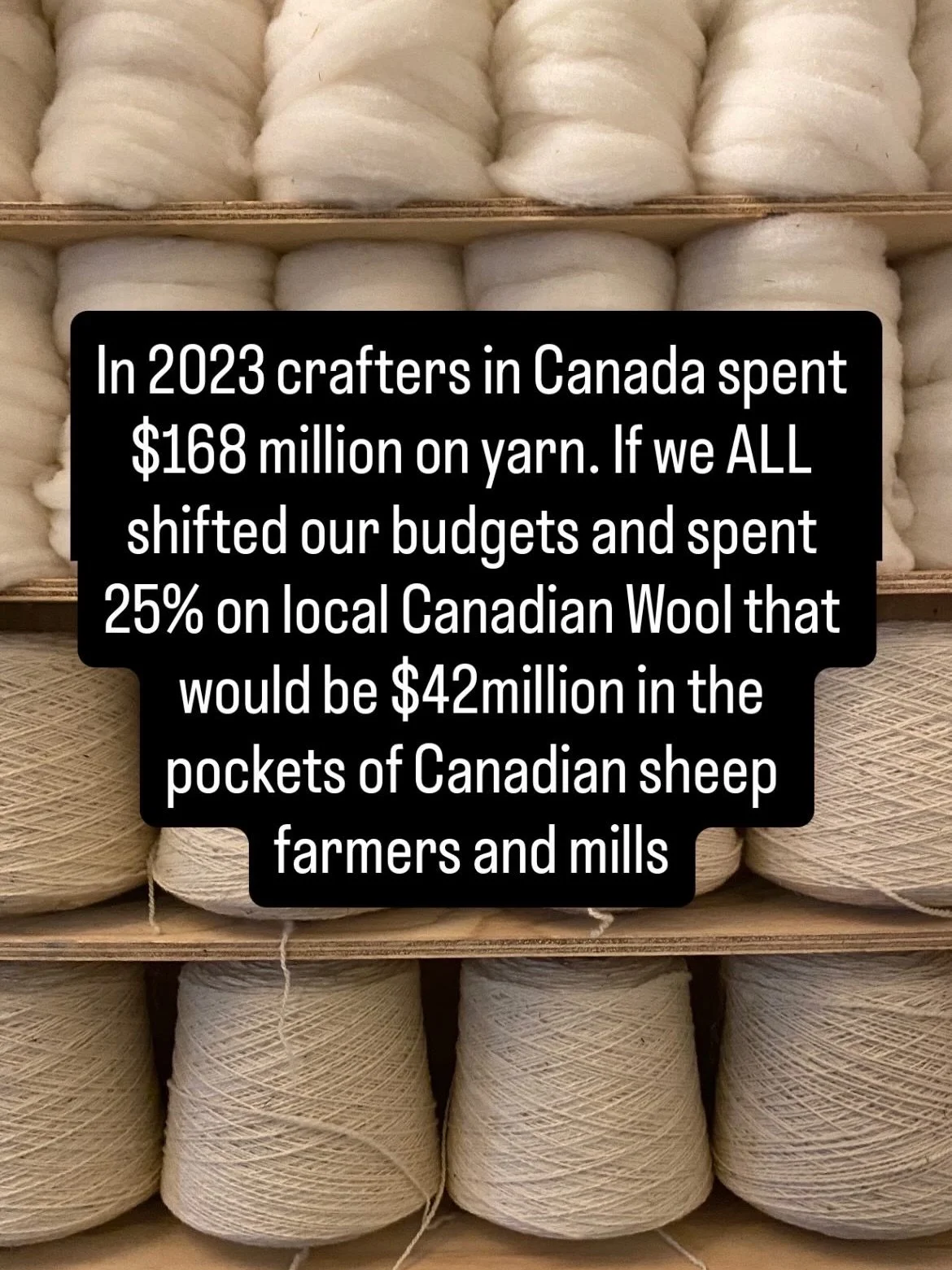
If you follow me on Instagram you may have seen this picture I posted the other day.
It felt like Black Friday lasted for 2 weeks this year, so I couldn’t help myself but try and cut through the black friday cheap consumption noise to highlight how we can make a difference with our dollars in the Canadian wool industry.
Doing research for my book The True Cost of Wool, I looked at the studies (unfortunately none have been done in the last few years) and statistics about how much money is spent in our country on yarn each year.
Canadian crafters spent $168 million on yarn in 2023!
This number doesn’t stipulate if it was 100% wool yarn, or cotton or acrylic etc. But it clearly indicates a thriving industry worth millions of dollars.
I put forward the suggestion that if each of us shifted our yearly yarn budget and committed to spending 25% on local Canadian wool it would be $42 million in the pockets of sheep farmers and mills.
That number was staggering to me when I read it. But I wanted to break it down a little further - what does 25% of our yarn budget mean? I asked a few people in my world what their yearly yarn budget was, and when I did the math - it isn’t impossible to commit 25%.
If you spend $150/year on yarn it’s only $37.50 - the equivilent to one skein of farm yarn - maybe it’ll be a nice, cozy toque (hat).
If you spend $500/year on yarn it’s only $125 - that’s like a pair of mittens, a pair of socks and a shawl!
If you spend $1000/year on yarn it’s only $250 - I can picture a beautiful sweater in a stunning palette of natural shetland sheep wool!
And if your yarn budget is closer to $5000/year it’s only $1250 - you could do matching Canadian wool toques & sweaters for everyone in your family!
If we shifted our buying habits to prioritize Canadian wool, it would have a great impact on our industry and community, here are a few:
It would mean less greenhouse gas emissions by limiting the global transport of wool.
More farmers have security on the land to continue stewarding land and sequestering more carbon from the atmosphere - storing it in the soil.
More at-risk sheep breeds thriving and genetic diversity being safeguarded.
More people (mostly women) in rural communities having meaningful work that pays a living wage.
Of course there is more to this conversation that an instagram post can’t cover - financial accessibility, domestic processing, wool quality and availability etc. But I think this post demonstrates that we are willing to spend money on yarn (literally millions) but we need to change the way our system works.